




Most car AC problems in Singapore trace back to just a handful of causes, many of which can be fixed in less than 30 minutes. A clogged cabin air filter, a dirty condenser, or mould on the evaporator core accounts for the vast majority of weak airflow, bad smells, and sluggish cooling that drivers deal with daily. Singapore's relentless heat (31–35°C year-round) and humidity (70–90%) push AC systems far harder than the temperate-climate conditions manufacturers design for, meaning your car's AC needs more attention than the owner's manual suggests. The good news: a few simple habits and checks can keep your system running cold and save you from repair bills that can easily hit S$500–S$1,500+
Weak airflow
If your AC’s air barely hits “guy trying to cool down a spoonful of soup” levels even on the highest fan setting, you’re almost always looking at a clogged cabin air filter. Thankfully, this is the single most common and easiest-to-fix AC issue. In Singapore's dusty, humid environment, filters tend to clog faster than the typical 12-month replacement interval. Less common causes include failing blower motors and blocked air intakes.
🛠️ How to repair: Thankfully, this is one of the easiest fixes you’ll do. In most cars, the filter lives behind the glove box: open it, release the retention clips on each side, lower the glove box, and you'll see the filter housing. Slide out the old filter (note the airflow direction arrow), vacuum out the housing, and slide in a new one. While you’re at it, you can even change the engine air filter too.
💰 Estimated costs: $15 - 40 (replacement air filter)
📆 When to replace: Every 10,000–15,000 km or every 12 months (whichever comes earlier), sooner if you notice reduced airflow or musty smells.
Warm air

This is a more complicated issue. If your car is blowing hot air (we all know a guy like that), it could mean a low refrigerant, a blocked condenser or compressor, or even a blown AC fuse.
🛠️ How to repair: To access your condenser, pop the hood and look at the front of your car, behind the grille for a flat panel with thin aluminium fins. Bugs, dust, leaves, and haze-season particulates accumulate here and choke airflow. With the engine off and cooled, rinse it gently with a garden hose from the engine side outward. Never use a high-pressure washer, as it could damage the fins and potentially puncture the condenser.
If giving the condenser a wash doesn’t fix the issue, you’re better off seeing a repair shop. Compressor repairs are generally far more involved, and recharging your car’s refrigerant without proper equipment or training can lead to explosions or even instant frostbite upon skin contact. Never attempt to recharge your car’s refrigerant by yourself!
💰 Estimated costs: $500 - $1,500 (compressor repair), $1,200 - $2,500 (compressor replacement), $50 - $80 (refrigerant recharge)
📆 When to replace: Every 6-12 months (condenser), when faulty (compressor and refrigerant)
Musty or mouldy smells/water pooling on passenger-side floor
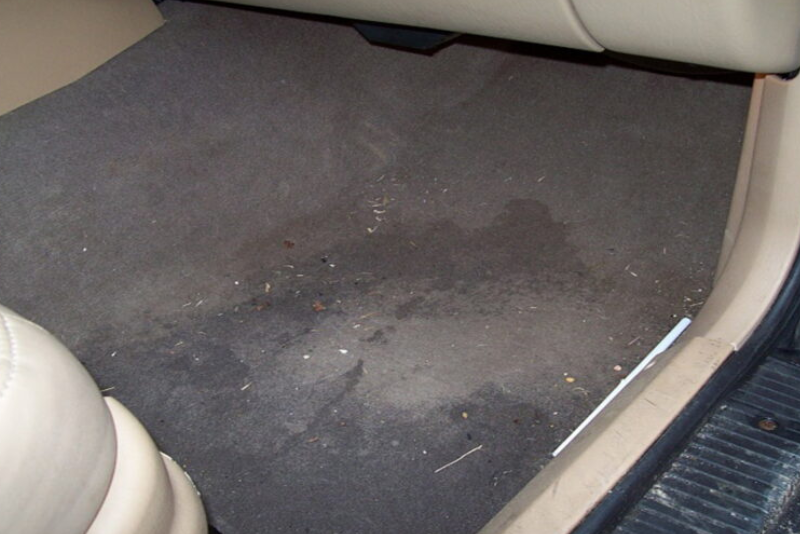
Singapore’s humidity sends all sorts of bacteria and fungi into overdrive, and closed-off areas like the space behind your dashboard where your evaporator core sits are an ideal breeding ground for them. When you’re running your car’s AC with an mouldy evaporator core, you’re passing infected air straight into your lungs, putting you at increased risk of infection.
🛠️ How to repair: Most auto shops and online retailers stock dedicated AC cleanser spray, which you can spray as directed into every single AC vent. Be sure to get the vents at your feet and in the backseat, and not just the ones on your car’s dashboard.
Once you’re done, find the car’s condensation drain tube (typically underneath the passenger side dashboard — look for a small protruding rubber hose) and spray for 20-30 seconds. Let it sit for 15-20 minutes so that the spray can work its magic, then start your car and run your AC on high for at least 10 minutes.
💰 Estimated costs: $10 - $20 (AC spray)
📆 When to replace: Every 6-12 months
Strange noises
Sometimes you need to throw in the towel and leave the work to someone who knows what they’re doing. A car has hundreds of parts, and any one of them could be the cause of that strange knocking (or grinding or whirring or clanking or or or) that you’ve been hearing lately. If your car’s making a strange noise or any of the above fixes don’t work, it's time to pull up to a mechanic who can actually identify the problem and fix it.
(Feature photo from: Orion Motor Tech)


